Introduction
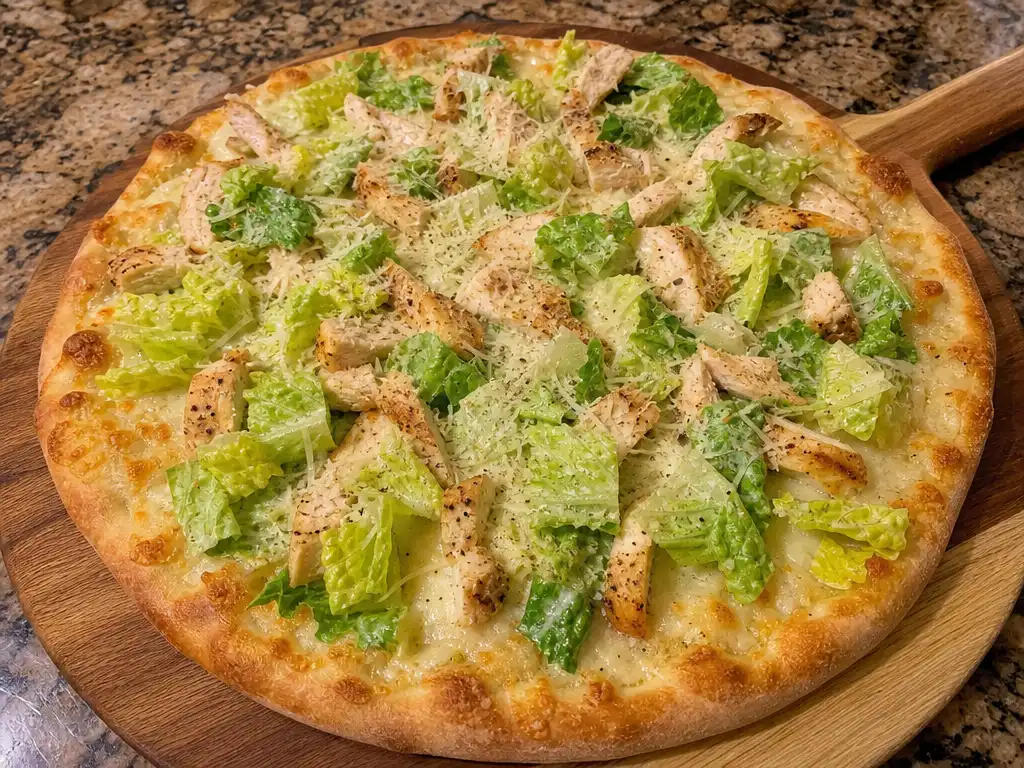
Chicken Caesar Salad Pizza is a brilliant culinary fusion that marries the bold, savory flavors of a classic Caesar salad with the comforting warmth and structure of a hand-tossed pizza. This innovative dish transforms traditional salad components—romaine lettuce, Parmesan cheese, garlicky Caesar dressing, and grilled chicken—into vibrant, texturally dynamic toppings on a crisp, golden crust. Far from being just a trendy gimmick, Chicken Caesar Salad Pizza represents a thoughtful evolution in modern comfort food: it satisfies cravings for both freshness and heartiness, offers impressive visual appeal with its bright green lettuce and snowy cheese shavings, and delivers layers of umami, tang, creaminess, and crunch in every bite. Whether served as an elevated weeknight dinner, a showstopping appetizer at a gathering, or a gourmet lunch option, this pizza redefines expectations—proving that salad doesn’t have to stay cold and bowl-bound to shine.
The History
The origins of Chicken Caesar Salad Pizza are not rooted in ancient culinary tradition but rather in the late 20th- and early 21st-century American restaurant innovation wave—where chefs began deconstructing and reconstructing familiar dishes to surprise and delight diners. The Caesar salad itself traces back to 1924, when Italian-Mexican restaurateur Caesar Cardini invented it in Tijuana, Mexico, using romaine, croutons, Parmesan, lemon, olive oil, raw egg, Worcestershire sauce, and garlic. Its popularity soared across the U.S., especially after the addition of grilled chicken turned it into a staple protein-packed lunch. Meanwhile, pizza’s Italian heritage evolved dramatically in America, particularly post-WWII, giving rise to regional styles like Chicago deep-dish, New York foldable slices, and California’s ingredient-forward artisan pies. The convergence of these two icons likely began in the early 2000s in upscale casual dining spots and gastropubs—places like California Pizza Kitchen (which pioneered BBQ Chicken Pizza in 1985) paved the conceptual path for “salad-on-pizza” experimentation. By the mid-2010s, food bloggers and viral recipe developers amplified interest, with versions appearing on Food Network, Bon Appétit, and even as limited-time offerings at national chains like California Pizza Kitchen and MOD Pizza. Today, Chicken Caesar Salad Pizza stands as a testament to American culinary remix culture—where reverence for tradition meets fearless flavor layering and textural contrast.
Ingredients Breakdown
Every exceptional Chicken Caesar Salad Pizza begins with intentionality—not just in selection, but in understanding how each component contributes to harmony on the plate. Below is a detailed, chef-level breakdown of why each ingredient matters:
- Pizza Dough: Preferably made with high-protein bread flour (12–14% gluten) for chew and structure; cold-fermented for 48–72 hours to develop complex, slightly sweet, nutty notes and superior oven spring. Optional additions include a touch of olive oil for tenderness or semolina flour dusting for rustic crunch.
- Caesar Dressing: Authenticity hinges on emulsification—freshly grated Parmigiano-Reggiano (not pre-shredded, which contains anti-caking agents), raw pasteurized egg yolk, Dijon mustard, fresh lemon juice, garlic confit or raw minced garlic, Worcestershire sauce, anchovy paste (for essential umami depth—not fishiness), and extra-virgin olive oil slowly whisked in. Store-bought dressings often lack balance and contain excessive sugar, preservatives, or unstable thickeners that break under heat.
- Grilled Chicken Breast: Boneless, skinless breasts brined in a solution of salt, sugar, garlic powder, black pepper, and herbs (like rosemary or thyme) for 1–2 hours before grilling over medium-high direct heat. Resting ensures juiciness; slicing against the grain maximizes tenderness. Alternatives include rotisserie chicken (shredded and lightly pan-seared for texture) or sous-vide chicken (precise 155°F/68°C for 1.5 hours).
- Romaine Lettuce: Only inner, crisp hearts—washed thoroughly, spun dry, and chilled. Iceberg lacks flavor and structural integrity; butter lettuce wilts too fast. Romaine’s sturdy ribs hold up to warm dressing and residual pizza heat without turning soggy.
- Parmesan Cheese: Microplaned freshly over the pizza just before serving—never baked directly onto the hot crust, as high heat makes it bitter and greasy. The fine shavings melt subtly into the dressing while retaining salty, nutty aroma.
- Homemade Croutons: Cubed day-old sourdough or ciabatta tossed in garlic-infused olive oil, sea salt, black pepper, and dried oregano, baked at 375°F (190°C) until golden and hollow-sounding. Store-bought croutons often contain hydrogenated oils and artificial flavors that mute the delicate Caesar profile.
- Optional Enhancements: A drizzle of lemon zest oil for brightness; a whisper of white truffle oil (use sparingly); pickled red onions for acidity; capers for briny pop; or microgreens (like arugula or pea shoots) for peppery nuance and visual finesse.
Step-by-Step Recipe
This meticulously engineered method ensures optimal texture, temperature control, and flavor layering—no step is arbitrary:
- Prepare the Dough (24–72 hours ahead): Mix 400g bread flour, 280g cold filtered water (70% hydration), 8g fine sea salt, and 2g instant yeast. Autolyse 30 minutes, then knead 10 minutes by hand or mixer until smooth and elastic. Bulk ferment at room temperature (72°F/22°C) for 2 hours, fold once, then refrigerate for minimum 24 hours (ideal: 48–72). Remove 2 hours before baking to temper.
- Make the Caesar Dressing (1 hour ahead): In a chilled stainless-steel bowl, whisk 1 large pasteurized egg yolk, 1 tsp Dijon, 1 minced garlic clove, 1 tsp anchovy paste, ½ tsp Worcestershire, and 1 tbsp fresh lemon juice. Slowly stream in ¾ cup extra-virgin olive oil while whisking vigorously until thick and glossy. Stir in ⅓ cup finely grated Parmigiano-Reggiano. Refrigerate covered—do not freeze.
- Grill & Slice the Chicken: Preheat grill to 400°F (204°C). Grill brined, oiled chicken breasts 6–7 minutes per side. Rest 10 minutes, then slice thinly against the grain. Toss gently with 2 tbsp Caesar dressing to infuse flavor and prevent drying.
- Pre-Bake the Crust: Preheat oven with pizza stone or steel at 500°F (260°C) for 1 hour. Stretch dough to 12-inch round on floured surface. Top sparingly: ¼ cup Caesar dressing swirled thinly (not pooled), 1 cup shredded mozzarella (low-moisture, whole-milk—adds subtle stretch without overwhelming), and half the grilled chicken. Bake 8–10 minutes until crust is puffed, blistered, and base is golden.
- Assemble & Finish: Remove pizza from oven. Immediately top with chilled romaine (tossed lightly in 1 tbsp dressing), remaining chicken, generous Parmesan shavings, croutons, and a final drizzle of dressing. Optional: finish with cracked black pepper, lemon zest, or microgreens. Serve within 90 seconds for ideal contrast—warm crust, cool crisp lettuce, creamy dressing, and melty cheese.
Tips
Mastering Chicken Caesar Salad Pizza demands attention to detail—here are professional-grade tips honed from hundreds of test batches:
- Dressing Consistency Is Key: Too thin? It’ll soak the crust. Too thick? It won’t coat lettuce evenly. Aim for “ribbon stage”—when lifted, dressing falls off spoon in slow, continuous ribbons.
- Temperature Discipline: Never place cold lettuce directly on piping-hot pizza. Instead, chill romaine for 30 minutes, then toss *just* with a light coating of dressing *after* the pizza exits the oven—this preserves crunch and prevents sogginess.
- Cheese Strategy: Skip heavy ricotta or feta—they clash with Caesar’s profile. Mozzarella provides neutral scaffolding; Parmesan adds sharpness only when raw and freshly grated. Avoid pre-grated “shelf-stable” Parmesan—it contains cellulose and won’t melt or flavor correctly.
- Crust Thickness Matters: A thin-to-medium crust (¼–⅜ inch) works best—thick crust retains too much heat and wilts greens prematurely. For extra crispness, par-bake the crust 3–4 minutes before topping.
- Lettuce Prep Ritual: Cut romaine crosswise into 1-inch pieces—not chiffonade. Smaller pieces distribute more evenly and cling better to dressing. Always spin dry *twice*: first in salad spinner, second on layered paper towels.
- Oven Hack for Home Cooks: No pizza stone? Use an inverted heavy-duty baking sheet preheated for 45 minutes. Broil on high for final 60 seconds to mimic deck oven char—but watch closely!
- Rest Before Serving: Let assembled pizza sit 45 seconds—long enough for dressing to lightly adhere to greens, short enough to retain chill and snap.
Variations and Customizations
While the classic iteration remains iconic, creativity thrives within this framework. Here are rigorously tested, chef-approved variations—each preserving the Caesar soul while expanding its boundaries:
- Vegetarian Caesar Pizza: Replace chicken with marinated, roasted chickpeas (tossed in lemon zest, smoked paprika, and garlic oil) and grilled halloumi cheese (pan-seared until golden and squeaky). Add sun-dried tomatoes for sweetness and depth.
- Keto/Low-Carb Version: Use almond-flour or coconut-flour cauliflower crust (pre-baked until very dry), full-fat Caesar dressing (check for hidden sugars), and double the Parmesan and croutons (made from crushed pork rinds or toasted almond slivers).
- Spicy Buffalo-Chicken Caesar: Toss grilled chicken in house-made buffalo sauce (cayenne, melted butter, vinegar, garlic), then layer with blue cheese crumbles *in addition to* Parmesan. Drizzle with ranch or blue cheese dressing alongside Caesar for hybrid tang.
- Mediterranean Twist: Add kalamata olives, roasted red peppers, and crumbled feta. Swap lemon juice in dressing for preserved lemon pulp—and use sumac-dusted croutons.
- Breakfast Caesar Pizza: Use a cornmeal crust, top with scrambled eggs cooked with chives and goat cheese, crispy pancetta instead of chicken, and arugula instead of romaine for peppery lift. Finish with lemon aioli.
- Gluten-Free Adaptation: Certified GF pizza dough (with xanthan gum), GF croutons (made from certified GF sourdough), and tamari-based Worcestershire. Verify all dressings and cheeses for hidden gluten (some Parmesans use wheat-based enzymes).
- Deconstructed “Pizza Board” Style: Serve individual components family-style: warm mini flatbreads, chilled romaine cups, warm chicken, croutons, shaved Parm, and chilled dressing for DIY assembly—ideal for parties or dietary flexibility.
Health Considerations and Nutritional Value
A single generous slice (⅛ of a 12-inch pizza) typically contains approximately 420–480 calories, with nuanced nutritional trade-offs worth understanding:
- Protein Powerhouse: Grilled chicken provides ~24g high-quality complete protein per serving—supporting muscle maintenance, satiety, and metabolic function. Pairing with Parmesan adds another 6g of bioavailable protein rich in casein.
- Fat Profile: Total fat ranges 18–22g—predominantly monounsaturated (from olive oil and Parmesan) and polyunsaturated (from chicken). Saturated fat stays moderate (~6–8g) if low-moisture mozzarella and lean chicken are used. Avoid excessive added oils or fatty dressings to keep it heart-healthy.
- Fiber & Micronutrients: Romaine delivers vitamins A, K, and folate; croutons contribute modest B vitamins and iron (especially if made from whole-grain bread). Adding cherry tomatoes or red onion boosts lycopene and quercetin—potent antioxidants.
- Sodium Awareness: Caesar dressing, Parmesan, and croutons are naturally sodium-rich. One slice may contain 650–850mg sodium—within FDA daily limit (2,300mg), but those with hypertension should opt for low-sodium Worcestershire, unsalted croutons, and reduced-salt Parmesan alternatives like nutritional yeast blends.
- Carbohydrate Context: Approximately 32–38g net carbs—mainly from dough and croutons. For blood sugar management, pair with a side of steamed broccoli or serve with a small mixed green salad to slow glucose absorption.
- Dietary Accommodations: Naturally low in sugar (<2g/slice), free from common allergens like nuts or soy (if dressings are verified), and easily adaptable for dairy-free (cashew-based Caesar, vegan mozzarella) or egg-free (vegan mayo–based dressing) diets—with careful label scrutiny.
- Balanced Indulgence: Unlike many pizzas laden with processed meats and cheese sauces, this version prioritizes whole-food ingredients, lean protein, and raw vegetables—making it nutritionally superior to standard pepperoni or meat-lovers pies without sacrificing satisfaction.
Ingredients
Makes one 12-inch pizza (serves 2–3)
- For the Dough: 400g bread flour (or 00 flour), 280g cold filtered water, 8g fine sea salt, 2g instant yeast
- For the Caesar Dressing: 1 large pasteurized egg yolk, 1 tsp Dijon mustard, 1 small garlic clove (minced), 1 tsp anchovy paste, ½ tsp Worcestershire sauce, 1 tbsp fresh lemon juice, ¾ cup extra-virgin olive oil, ⅓ cup finely grated Parmigiano-Reggiano, freshly ground black pepper
- For the Toppings: 1 boneless, skinless chicken breast (6–7 oz / 170–200g), 1 tbsp olive oil, ½ tsp kosher salt, ¼ tsp black pepper, 1 small head romaine lettuce (inner hearts only), 1 cup low-moisture mozzarella (shredded), ⅔ cup homemade croutons, ⅓ cup additional finely grated Parmigiano-Reggiano, lemon zest (optional), freshly cracked black pepper
Directions
- Prepare Dough: In a large bowl, combine flour and water; rest 30 minutes (autolyse). Sprinkle salt and yeast over top, then mix and knead 10 minutes until smooth and tacky but not sticky. Place in oiled bowl, cover, and ferment at room temperature 2 hours. Fold gently, then refrigerate 24–72 hours.
- Make Dressing: Whisk egg yolk, Dijon, garlic, anchovy paste, Worcestershire, and lemon juice in chilled bowl. Slowly drizzle in olive oil while whisking continuously until thickened. Stir in Parmesan and pepper. Refrigerate at least 1 hour.
- Brine & Grill Chicken: Dissolve 1 tbsp salt and 1 tbsp sugar in 2 cups water. Submerge chicken 1–2 hours. Pat dry, rub with olive oil, salt, and pepper. Grill over medium-high heat 6–7 minutes per side. Rest 10 minutes, then slice thinly against grain.
- Prepare Greens & Croutons: Wash romaine hearts, spin dry thoroughly, and chop into 1-inch pieces. Chill. Make croutons: toss 2 cups cubed sourdough with 3 tbsp garlic-infused olive oil, ½ tsp salt, ¼ tsp pepper, bake at 375°F (190°C) for 12–15 minutes until golden.
- Bake Pizza: Preheat oven with pizza stone/steel at 500°F (260°C) for 1 hour. Shape dough into 12-inch round. Spread ¼ cup Caesar dressing thinly. Sprinkle with mozzarella and half the chicken. Bake 8–10 minutes until crust is puffed and base golden.
- Finish & Serve: Remove pizza. Immediately top with chilled romaine (tossed in 1 tbsp dressing), remaining chicken, croutons, and Parmesan. Drizzle with extra dressing and lemon zest. Serve immediately.
FAQ
- Can I make this pizza ahead of time?
- No—assembly must happen post-bake. However, dough, dressing, grilled chicken, and croutons can all be prepped up to 3 days ahead and refrigerated separately. Romaine should be washed, dried, and stored in airtight container lined with paper towels for up to 2 days.
- Why does my lettuce get soggy?
- Sogginess results from either wet lettuce (insufficient drying), warm dressing applied too early, or placing greens on still-scalding pizza. Always spin romaine *twice*, chill it, and toss with dressing only *after* pizza comes out of oven—and serve within 90 seconds.
- Can I use store-bought Caesar dressing?
- You can—but most commercial versions contain added sugars, thickeners (xanthan gum), and lower-quality oils that separate or become greasy when warmed. If using, choose refrigerated, high-fat, egg-based brands (like Cardini’s or Ken’s Steak House), and add extra grated Parmesan and lemon zest to boost freshness.
- Is anchovy paste necessary?
- Yes—for authentic umami depth. It doesn’t taste “fishy” when balanced with lemon, garlic, and cheese. Substitute with ½ tsp soy sauce + ¼ tsp miso paste for vegetarian umami, though flavor will differ.
- What if I don’t have a pizza stone?
- An inverted heavy baking sheet preheated for 45+ minutes works nearly as well. Alternatively, bake on parchment-lined regular baking sheet—but expect less crispness. Avoid nonstick surfaces for high-heat baking.
- Can I freeze the dough?
- Absolutely. After cold fermentation, portion dough, wrap tightly in plastic + foil, and freeze up to 3 months. Thaw overnight in fridge, then temper at room temperature 1.5–2 hours before stretching.
- How do I reheat leftovers?
- Don’t reheat the fully assembled pizza—the lettuce will wilt irreversibly. Instead, reheat plain crust with cheese/chicken only (oven or skillet), then top anew with fresh romaine, croutons, Parmesan, and cold dressing.
- Can I make it vegan?
- Yes—with adaptations: use chickpea or tofu “chicken,” cashew-based Caesar (blended cashews, lemon, capers, garlic, Dijon, nutritional yeast), vegan mozzarella, and croutons made from GF bread. Ensure Worcestershire is vegan (most contain anchovies).
Summary
Chicken Caesar Salad Pizza is a masterclass in intelligent fusion—honoring the bold, anchovy-kissed complexity of Caesar salad while leveraging pizza’s irresistible warmth, texture, and shareability. It’s not merely “salad on pizza,” but a thoughtfully orchestrated interplay of temperature, fat, acid, salt, and crunch that delivers restaurant-worthy sophistication in a home kitchen.
With customizable proteins, dietary adaptations, and make-ahead flexibility, it bridges indulgence and wellness—proving that crave-worthy food can also be nutrient-dense, vibrant, and deeply satisfying without compromise.