Introduction
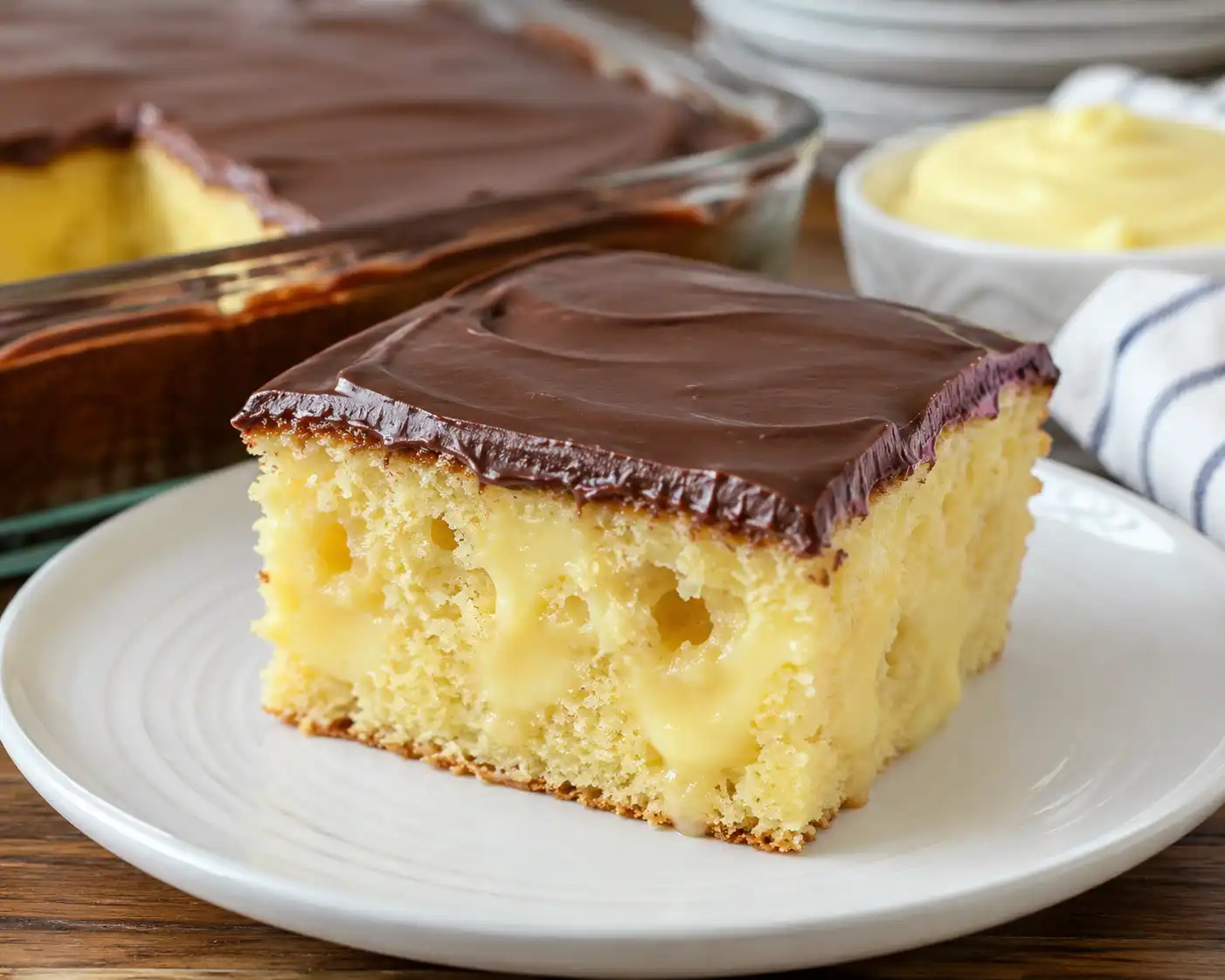
Boston Cream Pie Poke Cake From Scratch is a decadent, nostalgic dessert that marries the elegance of a classic Boston cream pie with the moist, indulgent magic of a poke cake. Despite its name, it’s not a pie at all—but rather a rich, tender yellow layer cake soaked in a luscious vanilla custard, crowned with a glossy chocolate ganache, and finished with a dusting of powdered sugar or a delicate swirl of whipped cream. Unlike store-bought versions or shortcut recipes relying on boxed cake mixes and instant pudding, this from-scratch rendition celebrates artisanal technique: a scratch-made vanilla sponge, a velvety homemade pastry cream (not pudding), and a silky dark chocolate ganache prepared with real cocoa butter and proper tempering principles. Every component is crafted with intention—no stabilizers, no artificial flavors, no preservatives—just pure, balanced sweetness, luxurious texture, and unmistakable depth of flavor. Whether served at a holiday gathering, a summer potluck, or as a weekend treat to savor with afternoon tea, this cake delivers nostalgia with nuance, comfort with craftsmanship, and joy with every forkful.
The History
The origins of Boston Cream Pie trace back to 1856 at Boston’s historic Parker House Hotel (now the Omni Parker House), where French chef M. Sanzian reportedly created the dessert for the hotel’s grand opening. At the time, “pie” referred to any sweet, flat, baked good served in a pie tin—even if it was layered cake—and the term stuck. The original consisted of two round, soft sponge layers filled with rich vanilla custard and topped with a smooth chocolate glaze—a revolutionary combination in mid-19th-century American pastry. It was officially designated the official state dessert of Massachusetts in 1996, a testament to its cultural resonance. The “poke cake” concept emerged much later—in the 1970s—with the rise of convenience baking, when home cooks began using a fork or skewer to poke holes in cooled cake layers and pour in sweetened condensed milk, Jell-O, or pudding to enhance moisture and flavor absorption. The fusion of these two traditions—Boston Cream Pie’s refined structure and the poke cake’s textural generosity—gained momentum in the early 2010s through food blogs and social media, evolving into today’s beloved hybrid: the Boston Cream Pie Poke Cake. This from-scratch version honors both lineages—respecting the historical integrity of the Parker House’s pastry cream while embracing the modern, forgiving technique of controlled liquid infusion—transforming a traditionally finicky dessert into something approachable, reliably moist, and deeply satisfying without sacrificing authenticity.
Ingredients Breakdown
Every ingredient in this Boston Cream Pie Poke Cake From Scratch serves a precise functional and sensory role—no filler, no shortcuts, no ambiguous substitutions. Below is a detailed, chef-level analysis:
- All-Purpose Flour (unbleached, 11–11.7% protein): Provides essential gluten structure without toughness. Sifted twice to aerate and ensure even distribution—critical for a fine, tender crumb. Avoid cake flour (too weak) or bread flour (too chewy).
- Granulated Sugar: Not just for sweetness—it tenderizes the cake by inhibiting gluten formation, retains moisture, and aids in caramelization during baking for subtle golden complexity.
- Large Eggs (room temperature): Act as emulsifiers, leaveners (trapping air when beaten), and binders. Yolks contribute richness and fat; whites add lift. Room temperature ensures uniform incorporation and optimal volume.
- Whole Milk (not low-fat or skim): Adds fat, lactose (for browning and tenderness), and casein proteins that support structure and moisture retention. Buttermilk may be substituted for tang and extra tenderness—but requires slight leavening adjustment.
- Unsalted Butter (European-style, 82–84% fat): Imparts unparalleled flavor, mouthfeel, and flakiness in the crumb. Clarified butter can be used for higher smoke point and intensified nuttiness—but standard unsalted butter yields superior texture.
- Pure Vanilla Extract (Madagascar Bourbon, double-fold): Contains over 200 aromatic compounds. Alcohol-based extraction ensures full flavor release—imitation vanillin lacks nuance and can taste medicinal.
- Baking Powder & Baking Soda: Dual-acting leaveners—baking powder provides primary lift; baking soda neutralizes acidity (from egg yolks, milk) and enhances browning. Freshness is non-negotiable—test by mixing ½ tsp with hot water; vigorous fizz = active.
- Salt (fine sea salt): Enhances all other flavors, balances sweetness, and strengthens gluten network subtly. Never omit—even in “sweet” desserts.
- Egg Yolks (extra, for pastry cream): Rich in lecithin, they provide unmatched thickening power, silkiness, and custard depth. Pasteurized yolks are recommended for safety when serving vulnerable populations.
- Cornstarch (not tapioca or arrowroot): Forms a stable, glossy, non-stringy gel with dairy—ideal for pastry cream that holds shape without weeping or breaking.
- Whole Milk & Heavy Cream (for pastry cream): The dual-dairy approach ensures ideal viscosity—milk contributes body and flavor; heavy cream adds unctuous richness and sheen.
- Granulated Sugar (for pastry cream): Dissolves fully into the hot dairy, preventing graininess and contributing to shelf-stable viscosity.
- Vanilla Bean (split & scraped): Seeds impart floral, woody, and creamy notes impossible to replicate with extract alone. Pod can be infused into warm milk for deeper aroma.
- Unsweetened Dark Chocolate (60–70% cacao, Callebaut or Valrhona): High cocoa butter content ensures smooth melting, glossy finish, and clean snap. Avoid “chocolate-flavored” coatings or chips—they contain vegetable oils that seize and dull flavor.
- Heavy Cream (for ganache): Minimum 36% milk fat for proper emulsion; lower fat causes splitting or dull appearance.
- Unsalted Butter (for ganache): Adds gloss, pliability, and rounded mouthfeel—especially critical for a ganache that remains spreadable yet sets firmly.
- Pinch of Salt (ganache): Cuts through chocolate’s bitterness and amplifies sweetness perception.
Step-by-Step Recipe
- Prepare Equipment & Ingredients: Preheat oven to 350°F (177°C). Grease two 9-inch round cake pans with softened butter, line bottoms with parchment paper, then flour pans lightly. Measure all ingredients precisely; bring eggs, milk, and butter to room temperature (68–72°F) for 1 hour. Weigh dry ingredients using a digital scale (grams preferred for accuracy).
- Make the Vanilla Sponge Cake Batter: In a stand mixer fitted with paddle attachment, cream butter and sugar on medium-high for 4–5 minutes until pale, fluffy, and ribbon-stage. Add eggs one at a time, beating 30 seconds after each addition until fully incorporated. Scrape bowl thoroughly. Whisk together flour, baking powder, baking soda, and salt. Alternate adding dry mixture and milk in three additions, beginning and ending with dry—mix only until just combined after each addition. Fold in vanilla extract. Batter should be smooth, satiny, and fall in thick ribbons.
- Bake the Layers: Divide batter evenly between prepared pans (use a kitchen scale for precision). Smooth tops with an offset spatula. Tap pans sharply on counter once to release air bubbles. Bake on center rack for 28–32 minutes—or until a toothpick inserted 1 inch from edge comes out clean (center may show slight moist crumbs; avoid overbaking). Cool in pans on wire racks for 15 minutes, then invert onto racks, peel off parchment, and cool completely (minimum 2 hours, preferably overnight wrapped in plastic).
- Prepare the Pastry Cream (Crème Pâtissière): Heat milk, cream, half the sugar, and vanilla bean pod (and seeds) in a heavy-bottomed saucepan over medium heat until steaming and small bubbles form at edges (do not boil). Meanwhile, whisk remaining sugar, cornstarch, salt, and egg yolks in a heatproof bowl until pale and thick (~2 min). Temper yolks: slowly whisk 1 cup hot dairy into yolk mixture, then pour mixture back into saucepan. Cook over medium-low heat, whisking constantly in figure-eights, until mixture thickens dramatically and coats the back of a spoon (170–175°F; ~4–5 minutes). Strain immediately through a fine-mesh sieve into a clean bowl. Press plastic wrap directly onto surface. Chill minimum 4 hours—or overnight—for full set and flavor development.
- Poke & Soak the Cake Layers: Using a thin, round-tipped skewer or chopstick, poke holes ½ inch apart across entire surface of each cooled cake layer—about 60–70 holes per layer. Gently spoon ¾ cup chilled pastry cream over first layer, using an offset spatula to spread evenly (do not press hard). Repeat with second layer. Let soak 20 minutes at room temperature—cream will absorb deeply, swelling the crumb without sogginess.
- Assemble the Layers: Place first soaked layer on a cardboard cake round or serving platter. Spread remaining pastry cream (reserving ~¼ cup for garnish if desired) evenly over top using an icing smoother. Carefully place second soaked layer on top. Lightly press to adhere. Refrigerate uncovered for 30 minutes to stabilize.
- Make the Ganache: Chop chocolate finely. Heat heavy cream in saucepan until just simmering (small bubbles around edges). Pour over chocolate in heatproof bowl. Let sit 2 minutes undisturbed. Whisk gently from center outward until smooth and glossy. Stir in butter and salt. Let cool at room temperature, stirring occasionally, until thickened to spreading consistency (about 20–25 minutes; 85–90°F). Do not refrigerate to speed cooling—it causes bloom or graininess.
- Glaze & Finish: Place chilled cake on a wire rack over parchment-lined sheet tray. Pour ganache over center and use an offset spatula to guide it evenly over top and down sides. Allow ganache to set 15 minutes at room temperature, then refrigerate 45 minutes to firm. Remove from fridge 15 minutes before serving. Optional: pipe rosettes of stabilized whipped cream (heavy cream + 2 tbsp powdered sugar + ½ tsp vanilla + ½ tsp cornstarch slurry, whipped to medium peaks) around perimeter and garnish center with toasted almond slivers or gold leaf.
Tips
- Temperature Is Everything: Cold pastry cream poured onto warm cake causes condensation and sogginess. Always chill cake fully and use cold cream—this ensures clean absorption, not pooling.
- Poke Depth Matters: Holes should penetrate ¾ of the way through the cake—not all the way—to prevent leakage but allow maximum saturation. Use consistent pressure; vary angle slightly to create interconnected channels.
- Don’t Skip the Rest: After soaking, chilling the assembled cake for at least 1 hour (ideally 3–4) allows starches in pastry cream to fully hydrate and set, preventing “weeping” when sliced.
- Ganache Timing Is Critical: If too warm, it melts the cream layer and slides off. If too cool, it becomes lumpy and streaky. Test consistency by dipping a spoon—if it coats thickly and holds a ribbon for 3 seconds, it’s perfect.
- Level Layers Like a Pro: Use a serrated knife and rotating cake turntable to trim domed tops before poking—ensures even stacking and professional appearance.
- Flour Your Parchment: After lining pans, dust parchment with flour—not just the pan. Prevents sticking even more effectively than greasing alone.
- Scale Your Batter: For consistent layers, weigh batter (target: 580g per 9-inch pan). Uneven layers cause uneven soaking and structural instability.
- Whip Cream Smartly: For garnish, add a pinch of cream of tartar or cornstarch slurry to stabilize—prevents deflation and weeping in humid conditions.
- Storage Wisdom: Keep covered in refrigerator up to 5 days. Bring to 65°F for 20 minutes before slicing—cold ganache cracks; cold cake tastes dense.
- Cut With Confidence: Use a long, thin, heated knife (dip in hot water, wipe dry) for clean slices. Wipe between cuts.
Variations and Customizations
This foundational recipe invites thoughtful, chef-driven innovation—always respecting structural integrity and flavor harmony:
- Espresso-Infused: Steep 1 tbsp finely ground espresso in warm milk for pastry cream; add 1 tsp instant espresso powder to ganache. Garnish with dark chocolate curls and candied orange peel.
- Bourbon-Vanilla: Replace 2 tbsp milk in cake batter with bourbon; infuse vanilla bean pod in warm cream for ganache with 1 tbsp bourbon. Dust with smoked sea salt.
- Maple-Cinnamon: Substitute ¼ cup pure maple syrup for part of granulated sugar in cake; add 1½ tsp ground cinnamon to dry ingredients. Use maple-infused pastry cream and white chocolate ganache with crushed pecans.
- Strawberry-Rose: Fold ⅓ cup seedless strawberry purée (reduced by half) into chilled pastry cream. Replace ganache with rosewater-scented white chocolate glaze and garnish with edible rose petals and fresh hulled berries.
- Gluten-Free: Use certified GF 1:1 blend (King Arthur or Bob’s Red Mill) + 1 tsp xanthan gum. Increase milk by 2 tbsp and add 1 tbsp apple cider vinegar to activate leaveners. Verify all extracts and chocolate are GF-certified.
- Vegan Adaptation: Cake: flax eggs (3 tbsp ground flax + 9 tbsp water), oat milk + 1 tbsp lemon juice, vegan butter (Miyoko’s). Pastry cream: coconut milk + cornstarch + agar-agar (1 tsp), blended with silken tofu for richness. Ganache: coconut cream + dairy-free dark chocolate (Enjoy Life). Requires precise temp control and longer chilling.
- Miniature Version: Bake in lined muffin tins (fill ⅔ full); bake 18–20 minutes. Poke centers with toothpick, soak with 1 tsp pastry cream each, glaze with mini ganache drizzle. Perfect for parties or portion control.
- Boozy Soak Option: Replace 3 tbsp of milk in pastry cream with Kahlúa, Grand Marnier, or dark rum—adds aromatic complexity without compromising thickness.
- Texture Contrast Topping: Before ganache sets, press toasted coconut flakes, crushed amaretti cookies, or freeze-dried raspberry powder into top for visual and textural interest.
- Layered Presentation: Split each cake layer horizontally into two thinner layers (4 total). Soak each individually, then stack with alternating pastry cream and thin ganache “kisses” between layers for ultra-luxurious mouthfeel.
Health Considerations and Nutritional Value
While inherently indulgent, this from-scratch Boston Cream Pie Poke Cake offers meaningful nutritional advantages over commercial or shortcut versions—and opportunities for mindful adaptation. Per standard slice (1/12th of cake, ~180g), approximate values are: Calories: 425 | Total Fat: 22g (13g saturated) | Carbohydrates: 54g (38g sugars) | Protein: 6g | Fiber: 1g | Sodium: 240mg. Key considerations:
- No Refined Stabilizers or Emulsifiers: Unlike boxed mixes or instant pudding, this recipe contains zero polysorbate 60, xanthan gum (beyond minimal cornstarch), or artificial thickeners—supporting digestive tolerance for sensitive individuals.
- Natural Dairy Fat Profile: Butter and cream provide conjugated linoleic acid (CLA) and fat-soluble vitamins A, D, E, and K2—bioavailable nutrients often missing in ultra-processed alternatives.
- Reduced Added Sugar Potential: By making pastry cream from scratch, sugar can be reduced by up to 25% without compromising texture (cornstarch still gels effectively), unlike instant pudding which relies heavily on sugar for viscosity.
- No Hydrogenated Oils: European-style butter and high-cacao chocolate eliminate trans fats and palm oil derivatives common in pre-made components.
- Protein & Satiety Balance: Egg yolks, dairy, and moderate protein content slow gastric emptying—promoting longer-lasting satisfaction versus high-glycemic, low-protein desserts.
- Customizable for Dietary Needs: As outlined in Variations, gluten-free, vegan, and lower-sugar options maintain integrity without “compromise” taste—unlike many commercially altered desserts.
- Mindful Enjoyment Framework: Best enjoyed as a deliberate, shared experience—not mindless snacking. Pairing with herbal tea (peppermint or ginger) aids digestion; a small slice satisfies more than larger portions of less flavorful, highly processed sweets.
- Food Safety Note: Because pastry cream contains raw egg yolks, always use pasteurized eggs or prepare a cooked custard base (as directed). Refrigeration below 40°F within 2 hours of assembly is essential.
For those monitoring intake: consider serving smaller portions (1/16th slice), pairing with fresh seasonal fruit compote (unsweetened), or enjoying as an occasional celebratory item rather than routine dessert—aligning with intuitive eating and Mediterranean-style moderation principles.
Ingredients
For the Vanilla Sponge Cake
- 2¾ cups (345g) unbleached all-purpose flour, sifted
- 2 cups (400g) granulated sugar
- 1 tbsp (12g) baking powder
- ½ tsp (3g) baking soda
- 1½ tsp (9g) fine sea salt
- 1 cup (240ml) whole milk, room temperature
- 1 cup (227g) unsalted butter, cubed, room temperature
- 4 large eggs + 2 large egg yolks, room temperature
- 2 tbsp (30ml) pure Madagascar vanilla extract
For the Pastry Cream (Crème Pâtissière)
- 1¾ cups (420ml) whole milk
- ½ cup (120ml) heavy cream
- ½ cup (100g) granulated sugar, divided
- 1 vanilla bean, split and seeds scraped (or 2 tsp vanilla paste)
- 6 large egg yolks
- ⅓ cup (40g) cornstarch
- ¼ tsp (1.5g) fine sea salt
For the Dark Chocolate Ganache
- 12 oz (340g) high-quality dark chocolate (60–70% cacao), finely chopped
- 1 cup (240ml) heavy cream
- 2 tbsp (28g) unsalted butter, cubed
- ¼ tsp (1.5g) fine sea salt
Optional Garnishes
- Stabilized whipped cream
- Toast almond slivers
- Edible gold leaf
- Dusting of confectioners’ sugar
- Fresh raspberries or blackberries
Directions
- Prep & Preheat: Center oven rack. Preheat to 350°F (177°C). Grease two 9-inch round cake pans with butter, line bottoms with parchment, then dust with flour. Set aside.
- Mix Dry Ingredients: In a medium bowl, whisk together flour, sugar, baking powder, baking soda, and salt until fully homogenous. Set aside.
- Cream Butter & Sugar: In bowl of stand mixer fitted with paddle, beat butter and sugar on medium-high for 4–5 minutes until very light, fluffy, and pale yellow. Scrape bowl thoroughly.
- Add Eggs: Add eggs and yolks one at a time, beating 30 seconds after each until fully incorporated and glossy. Scrape bowl after final addition.
- Alternate Wet & Dry: On low speed, add one-third dry mixture; mix until just combined. Add half milk; mix until just incorporated. Repeat, ending with dry mixture. Do not overmix—batter should be smooth and pourable but not runny.
- Finish Batter: Gently fold in vanilla extract with silicone spatula. Batter weight should be ~1160g total.
- Bake: Divide batter evenly between pans (580g each). Smooth tops. Tap pans firmly on counter. Bake 28–32 minutes—rotate halfway—until toothpick 1 inch from edge comes out clean. Cool in pans 15 min, then invert onto wire racks. Peel parchment. Cool completely (2+ hours).
- Make Pastry Cream: In saucepan, combine milk, cream, ¼ cup sugar, and vanilla pod/seeds. Heat over medium until steaming (180°F), not boiling. Meanwhile, whisk remaining ¼ cup sugar, cornstarch, salt, and yolks until pale. Temper: slowly whisk 1 cup hot dairy into yolks, then return all to saucepan. Cook on medium-low, whisking constantly, until thick, glossy, and coats spoon (170–175°F). Strain into bowl; cover surface with plastic. Chill ≥4 hours.
- Poke Layers: Use skewer to poke holes ½” apart across both cakes. Spoon ¾ cup pastry cream over each. Spread gently. Let soak 20 min at room temp.
- Assemble: Place first layer on board. Spread remaining pastry cream evenly (reserve 2 tbsp if garnishing). Top with second layer. Refrigerate uncovered 30 min.
- Make Ganache: Chop chocolate. Heat cream until simmering. Pour over chocolate. Wait 2 min. Whisk gently to melt. Stir in butter and salt until shiny. Cool to 85–90°F (20–25 min).
- Glaze: Place cake on wire rack over parchment. Pour ganache over center. Use offset spatula to spread evenly over top and sides. Let set 15 min at room temp, then refrigerate 45 min.
- Serve: Remove from fridge 15 min before slicing. Cut with hot, dry knife. Serve chilled or at cool room temperature.
FAQ
- Can I make this cake ahead?
- Absolutely. Bake layers up to 3 days ahead—wrap tightly in plastic and freeze. Thaw overnight in fridge, then bring to room temp before poking. Pastry cream keeps 5 days refrigerated. Ganache can be made 3 days ahead and gently rewarmed. Fully assembled cake lasts 5 days refrigerated.
- Why did my pastry cream curdle?
- Curdling usually results from overheating (above 180°F) or insufficient whisking during cooking. Always use a thermometer and whisk constantly in figure-eights. If minor lumps form, strain immediately through fine mesh—don’t try to “beat out” lumps after cooling.
- Can I use instant pudding instead?
- You can—but it compromises authenticity, texture, and flavor. Instant pudding contains gums, hydrogenated oils, and excessive sugar, resulting in a cloying, gummy, and artificially flavored filling that doesn’t complement the nuanced cake or ganache.
- My ganache cracked or separated. What went wrong?
- Separation occurs from incorrect temperatures (cream too hot or chocolate too cold), water contamination (even a drop!), or over-whisking. Ensure equipment is bone-dry, cream is hot but not boiling (190°F max), and chocolate is at room temperature. If separation occurs, gently rewarm over double boiler while whisking—do not add water.
- How do I prevent cake from crumbling when poking?
- Ensure cake is fully cooled (preferably chilled 30 min before poking) and use a thin, sharp skewer—not a fork with wide tines. Apply gentle, vertical pressure. If cake is still warm or underbaked, it will tear.
- Can I bake this as a single-layer sheet cake?
- Yes. Use a 9×13-inch pan (greased and parchment-lined). Bake 35–40 minutes. Poke thoroughly. Soak with 1½ cups pastry cream. Glaze with full ganache batch. Slice into 15–20 bars.
- Is there a lower-sugar option without artificial sweeteners?
- Yes. Reduce sugar in cake by ¼ cup (50g) and in pastry cream by 3 tbsp (30g). Compensate with 1 tsp inulin (chicory root fiber) in pastry cream for body and mild sweetness. Ganache sugar is inherent to chocolate—choose 70%+ cacao to naturally reduce added sugar.
- <